Making fat, breaking fat: Simplest Peptides
I wanted a simpler account of a fat-metabolism peptide. A rat-tissue experiment split that wish into two verbs: making fat and breaking fat down.
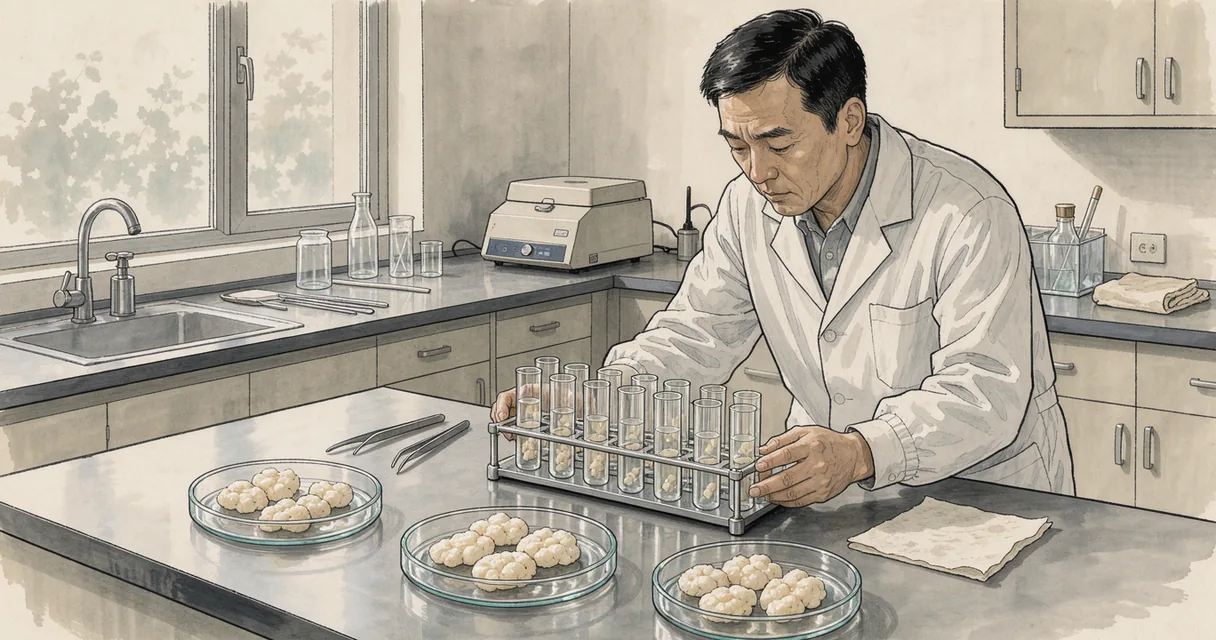
Rat fat pads, 1993
A short growth-hormone fragment did something quite specific in an experiment with rat fat pads outside the animal: it inhibited fat formation, while showing no significant fat-breakdown effect in the glycerol-release assay. The fragment was synthetic hGH 177-191. Its inhibition of fat formation matched that of intact human growth hormone in this experiment.
That is a wonderfully awkward place to begin a site called Simplest Peptides. The everyday phrase ‘fat burning’ seems easy enough until a paper separates the jobs it has bundled together. Making new fat and releasing stored fat deserve different verbs. My earlier shorthand had concealed the difference.
The imagined assay scene above introduces that tissue experiment; it is an illustration, not a photograph of the work.
Fat synthesis
The longer word in the paper is antilipogenic: inhibiting the formation of fat. It sounds more difficult than ‘fat burning’, but it makes a smaller, clearer claim. An earlier experiment in fat-cell and liver-cell preparations connected growth hormone and its hGH 172-191 fragment to inhibition of acetyl-CoA carboxylase, an enzyme involved in making fatty acids.
For my taste, a named reaction is more satisfying than a sweeping metabolic claim. There is something concrete to investigate: a particular fragment, a preparation, an enzyme. The fat-synthesis essay follows those experiments into a later study of body-weight gain in obese mice. The fragment names remain attached to their own results.
AOD-9604 in mice
AOD-9604 enters this story through metabolic work on a synthetic domain of human growth hormone. In a later mouse experiment, chronic treatment reduced body weight and fat in obese mice. Removing a particular receptor abolished the chronic response, yet acute increases in energy expenditure and fat oxidation persisted.
That finding complicates my tidy pair of verbs in a useful way. Even the time of the measurement matters. The mouse experiment gives the receptor and the timescale separate jobs to explain.
Rabbit cartilage and human tolerability
Cartilage takes the story into another tissue. In a rabbit knee osteoarthritis model, AOD9604, with or without hyaluronic acid, reduced cartilage-degeneration scores compared with saline. The rabbit-cartilage essay asks how much the word ‘repair’ can fairly carry when that is what was measured.
The human question deserves room of its own. A report on oral AOD9604 trials in obese adults described tolerability indistinguishable from placebo across the programme. I take that comparison seriously, within the exposures it covered. Human tolerability puts those boundaries beside the finding.
The reading list gathers the studies. The question running through them is pleasantly stubborn: which action did this particular experiment actually measure?